
September 5, 2023
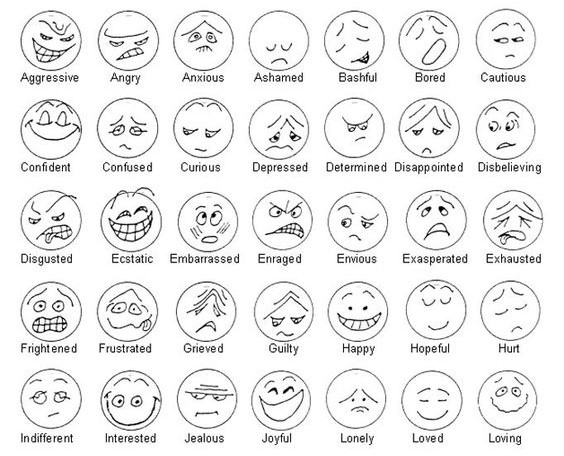
If you ask one hundred people, you will get one hundred different explanations for what an emotion is and the labels that describe them. When you search the internet, you will find articles that describe theories of emotions (theories aren’t facts), charts with faces and labels, lists of feeling words, and examples explaining emotions and the physiological events usually associated with them.
This article is not about those things.
Some try to separate good feelings and bad feelings. This usually means the feelings someone enjoys or doesn’t enjoy. However, feelings aren’t good or bad, they just are. What you do with your emotions, how you express them or use them, gives you good or bad results (positive or negative feedback). This post is about core emotions, expressing them, and the science behind them.
6 Core Emotions
These are the core emotions that I was taught and that I teach my clients: Happy/Joy, Sad, Anger, Fear, Guilt, Shame. Each of these emotions are distinct from each other. People often use other words that mean the same thing, such as frustrated or upset (Anger), or that describe one of these emotions in lesser or greater intensity.
However, I submit to you that most people minimize their feelings, for some reason. However, once they embrace one of the above core emotions, their emotional engagement and expression is much more poignant, felt, and productive. When someone labels their feeling as hurt when they are actually masking anger, there’s a reason. Are they afraid of their own anger (did they grow up in a home where anger was unacceptable from children)? Are they afraid of the consequences of allowing themselves to be angry (destroy something or someone, or others won’t be able to handle it)? Once it turns on it will never turn off? Or is hurt simply more acceptable to those around them than anger (manipulation)?
Why Not More?
Some have argued for other labels to be included in this list, like pain, hurt and passion. I do not include them because they usually fall under one of the core emotions above, or they are actually a belief or state as will be discussed in the following section. For example, on many lists or charts of emotions you will find anxious. What is happening for someone who is anxious? Anxious because of something that might or that they know will happen next? Anxious because they don’t know what will happen next? These are fear based reactions. Anxiety and nervousness are about fear (anxiety is actually a state).
If the number one fear that people have is public speaking, what do they say before they go up in front of the audience? They say they are ‘nervous’ or ‘anxious’ or that they ‘have butterflies’. They don’t say they are scared. But they might say that they are afraid they are going to… make a fool of themselves… fall down… screw up… faint… etc. What they are expressing is their fear of what might happen, which creates the state of anxiety (meaning physiological symptoms).
So, fear is the emotion and anxiety is the state. Semantics? Read on.
Emotions vs. States vs. Beliefs
I have seen many charts of emotions and lists of feeling words. Look at many charts or lists and you will find words like, confused and bored and tired. These are not emotions, they are states. To be in a state of ‘confusion’ can involve many different emotions. People who describe themselves as bored are not describing an emotional condition, they are describing a physiological one.
You will also often see words like shy and stupid, which are not emotions or states. They are beliefs. If someone believes themselves to be shy, how might they act or react to others, or even feel? Afraid maybe? Take stupid for example. We have all heard someone say, “I feel stupid.” That is not an emotional acknowledgment, that is their belief. A person who believes themselves to be stupid can have many different feelings, likely including embarrassment which is a form of Shame.
What are you saying here, Todd? Well, it has been my experience that people don’t usually communicate their feelings honestly. People minimize and skirt their true emotions for whatever reason. However, when people do begin to own their emotions, and honestly express them, they gain greater clarity, act with stronger boundaries, and feel better about and more confident in themselves and the world around them.
The Science of Affect
The darling of medical and psychological research right now is brain science, including emotions. You can find one example here. Even Facebook did their own study to see how they could affect the emotions of their users.
However, this study of emotions is not new. Perhaps one of the most notable researchers of emotions was Paul Ekman who began his research into emotional expressions with his Master’s thesis in 1954. His original six core emotions (sadness, fear, anger, happiness, surprise, disgust) are widely used today. He expanded his list to eleven in 1990 to include amusement, contempt, contentment, embarrassment, excitement, guilt, pride in achievement, relief, satisfaction, sensory pleasure, and shame. Notice his original six are not in the new list.
4 Basic Emotions
Then one day a colleague shared with me four basic emotions: mad, sad, glad and scared. I now use this as a tool to help clients identify what they are feeling with a simple vocabulary. But as I looked further into this definition, there was much more to it. I ran across a post on Psyblog referring to a research article that supports this basic set of emotions focusing on the 42 facial muscles and the expressions they create. This allows for others to develop over time, even a fraction of second later, as an extension of these basic emotions.
What does all of this mean? What it means is there is not endless emotions, but variations around a core set. Whether they also involve states or beliefs, there is an emotion driving it. What you do with your emotions, how you choose to express them, contributes greatly to your quality of life.

CEO at Thrivology
Todd has a Master of Science degree in Marriage & Family Therapy and has been a therapist for over 28 years. He has extensive experience with teenagers and families treating relational and behavioral problems. Check out his first book at https://a.co/d/aV4qytm
Latest posts by Todd Call (see all)
- How Thankful Are You Today? - November 26, 2024
- Latent Anger: The Hidden Force Shaping Your Life - October 8, 2024
- Supplements To The Rescue - September 10, 2024